













As with the commercial casinos, the tribal establishments also had an unforgettable year in terms of numbers. According to the new fiscal year report from the National Indian Gaming Commission (NIGC), In 2022, 246 tribal governments operating 504 facilities in 29 states generated approximately $40.9 billion in gross revenue. Tribal government gaming operations generated an additional $5.3 billion in gross revenue from ancillary/gaming-related enterprises, including hotels, restaurants, entertainment, and related operations. As a result, Indian gaming accounted for a total of $48.4 billion in direct gross revenues in 2022. The number is a 4.9% uptick from FY2021 and the best year on record for the industry.
“This year’s historic revenue reflects the resiliency of many tribal gaming operations, and how tribal gaming continues to rebound and remain strong. Tribal governments and the operations they license continue to explore new and innovative ways to expand and deliver world-class experiences to cultivate sustainable economies. Across Indian country, tribes pursue economic sustainability through gaming by relying on the robust regulatory reputation for which Indian gaming is well known, and made better when supported by efficient and effective measures,” said NIGC Chair E. Sequoyah Simermeyer.
Despite the dip in 2020 due to the Covid-19 pandemic, where GGR was recorded at $27.8bn, the tribal gaming industry has more than recovered; making $39.0bn in 2021. The FY 2022 revenues are calculated from the independently audited financial statements of 519 gaming operations owned by 244 federally recognized tribes. Indian gaming operations are located on Indian land in 29 states. Seven of NIGC’s eight regions showed an increase over FY 2021.
REGION BY REGION
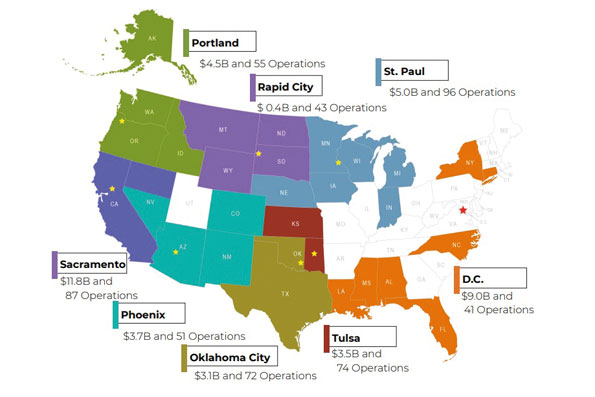
The only region not to experience growth over the past fiscal year was the Sacramento region (Comprising California and Northern Nevada) which was essentially flat year-over-year. It was $11.9B in 2021 against $11.8bn in 2022, but curiously with the opening of nine new operations.
The region with the biggest year-over-year growth was Phoenix. Tribal casinos in Arizona saw revenues jump more than 15% to $3.7 billion in the last fiscal year. While the reporting does not break down what verticals the revenue is coming from, the jump times with a change in Arizona law allowing for expanded table games at the state’s tribal casinos in addition to the legalization of sports betting. Only one new operation was opened.
Tulsa and DC also saw large increases of 11% each. Tulsa recorded GGR of $3.2bn in 2021, going up to $3.5bn in 2022. DC recorded GGR of $8.1bn in 2021, going up to $9.0bn in 2022. Tulsa continued with the same number of stores, while DC had one less than in 2021.
The fourth largest increase was Rapid City (9.1%), albeit with the lowest billing amount of all regions ($0.4bn). Oklahoma City, at $3.1bn, was the fifth increase for tribal games (4.0%). Meanwhile, Portland and Saint Paul, with almost $5bn, grew at 1.0% and 3.4%, respectively.
CONCLUSIONS AND CHALLENGES
Approximately 8% of gaming operations reported more than $250 million of GGR in FY 2022 and their aggregate revenues made up more than half (51%) of the total GGR. In comparison, 55% of tribal gaming facilities reported less than $25 million in revenues and this group represents about 5% of the total GGR share. This is consistent with past results though and not a sign that the tribal gaming industry is consolidating.
In order to expand the offer, for some years tribal casinos have focused their investment on essential factors. Marketing, promotions and wages were some of the most significant expenses. Marketing expenses increased slightly compared to previous years, and casinos of every size spent more on employee benefits and incentives.
According to Wipfli, Slot machines continue to be the primary source of gaming revenue, driving the majority of profits. Unlike other states and commercial casinos, sports betting is prohibited in much of the tribal gaming regions. Tribes are the sole sports betting offers in California, Connecticut, and Florida. However, this does not guarantee future revenue as battles over sports betting continue to play out.
In fact, some states are willing to go to court to gain access to those benefits. For example, a Florida cardroom operator has asked a federal appeals court to reverse its decision to uphold an agreement that gives the Seminole tribe exclusive rights to sports betting in the Sunshine State.
The average net profit margin was approximately 30%, which is roughly six percentage-points lower than in 2021. Native American casinos widened their operating expense margins almost two percent, despite facing inflation and higher interest rates and spending more on staff and marketing.
Inflation and labor shortages also continue to drive up costs for operators, as noted by Wipfli survey. There is also more stringent competition on the horizon and more competition for discretionary dollars for tribal casinos compared to the pandemic era.
In 2022, Indian Gaming was responsible for generating $37 billion in direct and indirect wages throughout Indian Country and nearby communities. Indian gaming operations paid nearly $8 billion in wages to their direct employees. Tribal industry generated an additional $29 billion in wages that resulted from Indian gaming employees spending their disposable incomes, casino operations purchasing activities, capital expansion projects, and transfer payment spending activities.
In 2022, Indian gaming was responsible for generating $11.5 billion in federal taxes, $4.6 billion in state taxes, and $1.4 billion in county taxes – a total of $17.5 billion. Over the past decade, Indian Gaming has delivered more than $140 billion to the federal and state governments in the form of employment, income, sales, and other taxes, and reduced general welfare payments. Of this total, tribes shared more than $15 billion to state governments through revenue-sharing agreements codified in tribal-state gaming compacts.
In 2022, Indian gaming delivered more than 680,000 jobs for American families. Of this total, 38.7 percent, or 264,963, were direct jobs, and 61.2 percent, or 419,195, represented indirect jobs. These indirect jobs are generated from Indian gaming wages, purchasing activity, capital expansion, and related activities. As a result, Indian gaming remains among the top 20 employers in the United States.
BILL ANOATUBBY INDUCTED INTO AGA HALL OF FAME
The development and growth of the tribal industry has invaluable people throughout its history. One of them is Bill Anoatubby. The American Gaming Association decided to induct him into the 2023 class of the Hall of Fame. Anoatubby has served as Governor of the Chickasaw Nation since 1987. Early in his tenure, Anoatubby recognized the important role gaming could play in advancing sustainable economic development and self-determination for the tribe. Since 1987, gaming operations have helped drive the number of Chickasaw Nation employees from 250 to more than 14,000, expanding tribal assets two-hundredfold.
As Governor, Anoatubby oversees the tribe’s operation of more than 100 diversified businesses—including 24 tribal gaming locations—generating funding for 200-plus programs and services that benefit education, healthcare, housing and more for Chickasaw families, Oklahomans and their communities. Anoatubby also played an integral role establishing the Indian Gaming Association and Oklahoma Indian Gaming Association, as well as negotiating the 2004 Oklahoma gaming compact which solidified the future of tribal gaming in the state. Under Governor Anoatubby’s direction, the Chickasaw Nation also places a strong emphasis on preserving and sharing its heritage, history, language and culture.