





















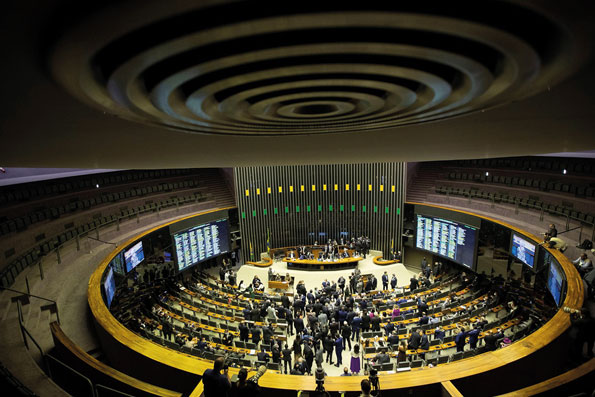
The Chamber of Deputies of the Brazilian Congress approved, on September 13th, the basic text of Bill 3626/23, which regulates sports betting. Among the main changes introduced, it is established that the regulation will also include both other online games and virtual casinos, taxing the income of betting companies, prizes for winners and will also create an initial subsidy to authorize websites to operate legally.
One of the most commented points in the discussions between the different actors in the sector was the tax on the income of betting sites which, despite the intention of federal legislator Adolfo Viana to lower it, will remain at 18 %. The initial fee to authorize the operation of the sites will be 30 million reais (approximately 6 million dollars), and these will be able to operate for 3 years. Prizes for individuals will be taxed at 30 %, including the initial investment as well as the profits.
The bill, which will now be analyzed by the Senate, will also establish a new distribution of income, payment of fees, requirements and restrictions, compared to what was presented by Lula da Silva’s government with the Provisional Measure (MP) of July.
The distribution of revenue collected between government areas is modified. Social Security will drastically reduce its percentage, dropping from 10 to 2%, while the Ministry of Sports will increase from 3 to 4%. Likewise, the Ministry of Tourism will also be included in the distribution of funds.
Another point established by the bill also stipulates that betting companies must be registered in Brazil. “Only legal entities constituted in accordance with Brazilian legislation, with headquarters and administration in national territory, that meet the requirements of the regulations issued by the Ministry of Finance, may obtain authorization to operate fixed probability bets,” the text says.
Brazil: An iGaming opportunity
In 2020, the gross revenue of the iGaming industry was 1.9 billion euros, and by 2026 it is estimated to be 2.3 billion euros, having the potential to represent 1 % of Brazil’s Gross Domestic Product (GDP) of 1.5 trillion euros. Currently, Brazil presents high and positive statistics that position it as one of the largest markets in the world. In fact, in 2022, the estimation of Brazilians participating in some activity related to sports betting and online casinos was more than 46 %. So active is the market, that the 2023 projection is to have a revenue per user (ARPU) with an average of 801.60 euros, the highest in Latin America.
GDP was USD 1.61 trillion, with a growth of 2.7 %. According to the IMF, Brazil is the 12th country with the highest growth potential, ahead of countries such as Australia, Mexico, and Spain. In other words, Brazil’s GDP can compete with top economies based on estimated data from 2020 to 2026.
By the end of 2023, online casino gaming revenues are projected to reach 0.91 billion euros. A figure that undoubtedly hints at a country with a strong casino gaming culture. By 2027, the prediction is that there will be an increment in approximately 2.25 million users participating in online casino games. To confirm that prediction, it is estimated that 48 % of Brazilian users play casino games 1 to 3 times per week.
A study conducted by online casino OKTO revealed that the majority of players reside in six of the country’s states: 33,9 % in São Paulo, 24,54 % in Rio Grande do Sul, 14,54 % in Minas Gerais, 9,06 % in Paraná, 6,58 % in Santa Catarina, and 2,34 % in Río de Janeiro.
These numbers indicate the greatest concentration of users in the three southern states of Brazil. At the same time, the six states with the highest number of users coincide with the most economically developed states and the most significant metropolitan areas. Users in Rio Grande do Sul have sessions with an average time of 9 minutes and 54 seconds, while in São Paulo, the average time per session is 1 minutes and 56 seconds. This places Rio Grande do Sul as the state with the lowest online casino gaming activity rate.
In addition to demographic data, player preferences in terms of online casino games are as follows: 78 % play online roulette, 66 % play online blackjack, 64 % play online table games, 63 % play online slots, 61 % play online video poker, and 50 % play live dealer games.
Although casinos games are popular among players, the general consensus from market players is that the majority of users play casino games on sports betting sites. A country with such a large population and with such a large market, it is not a question of one or the other. As growth projections indicate, Brazil has everything to be one of the powerhouses of the iGaming industry, and that, in itself, is an opportunity for every online casino company.
The fact that so many users are gambling online in Brazil is also beneficial for online casinos. It means all those users know how to interact with an online site. They know the industry, and they trust it. This makes them easier to attract online than people who have never placed a virtual bet online.
Sportsbook user behaviour
The sports betting market in Brazil is significantly larger than that of online casinos in terms of number of users. The first evidence showing the difference between the two markets is the revenue generated through online sports betting. During 2020, the operations recorded 1.2 billion euros. In 2023, the expectations are an increment that reaches 2 billion euros, almost doubling in three years.
This sum is directly related to the number of online gambling users in Brazil: by 2027, it is believed that there will be 2.25 million active users. The sports betting demographics in Brazil share many similarities with the online casino demographics presented above. However, in terms of Google searches, the states of Tocantins and Rondônia lead the way in searches for the keywords “bookmakers” and “sports betting”, respectively.
Favouritism for betting on football is no secret in Brazil or the rest of Latin America. Corinthians and Flamengo, the two most popular teams in the country, have more than 30 million fans each. In addition, 39 of the 40 First Division teams have online sportsbooks as main sponsors.
The frequency with which Brazilian players bet is another attractive aspect of this market. In a survey develop by Globo, 18 % of respondents said they bet seven days a week, 16 % said they bet between four-to-six days a week. The majority, 48 %, bet between one and three times a week. Another 18 % bet between one and three times a month.
Bridging online casinos and sports betting
Overall numbers show a clear difference between the casino and sports betting markets, placing sports betting well ahead of online casinos. This difference is supported by the preference of users in Brazil when choosing where to spend their online gambling money: 69 % bet in online sports betting, 38 % bet in fantasy games, 36 % bet in online casino, and 32 % bet in online bingo. The number of monthly Google searches reflects the trend towards online sports betting: 135 000 look for bookmakers, 33 100 look for sports betting, and 5400 look for online casinos.
Technical and technological requirements in the Brazilian iGaming industry
In the case of Brazil, there are 3 critical points to highlight regarding the technical and technological requirements iGaming operators need to consider to satisfy the needs of their users.
Based on a Globo study, when asked what factors they consider to be positive when evaluating an online casino/betting house experience, 54.2 % of players responded – security and a secure connection certificate. This aligns to Brazil’s suffering more than 103 million attempted cyber-attacks in 2022. User responses clearly indicate that all online casinos and betting sites must operate with the highest security standards for data protection and payment methods.
Over half of the online casino and sports betting users prefer to log in from their mobile phones. This is mainly because, as mentioned above, most users live in metropolitan areas that require long journeys by public transport, and this is when many take this as the opportunity to gamble and bet. As a result, websites must be fully optimised for mobile devices, as must the games they offer in their catalogue. Otherwise, you risk losing a large number of users.
Despite Brazil already having 5G connectivity in several regions and being one of the fastest in terms of internet speeds in Latin America, many users prefer downloading apps to play and gamble online. They feel more secure when their data and money are processed through an app. They know that they will not have connectivity problems. While many casinos focus on optimising their sites for mobile devices, in Brazil it is a real advantage to offer an app to play and gamble.